The 3x rent rule is made up. San Francisco's problem is supply
Findigs CEO Steve Carroll on why the 3x gross-income rule for renting is arbitrary, and why San Francisco's affordability crisis is a housing supply problem, not an AI-boom problem.

By Steve Carroll
Hi, I'm Steve. I'm the founder and CEO of Findigs. We're a venture-backed technology company, Series C, based in New York, and we work in rental housing.
I love the housing market. Housing sits at the center of the rest of your life. It's where your kids go to school, where you buy groceries, and which jobs you can reach. I'm passionate about it.
I also love thinking about incentives, in this market and in building anything. I love the Charlie Munger quote: "Show me the incentive, I'll show you the outcome." In these sessions we're going to explore the market incentives and trends we see from our vantage point.
Today, two topics: the rent crisis, and San Francisco.
The rent crisis
A video has been making the rounds. A woman begins: "I think I've discovered that I'm stupid"... she's not. She had lived on the West Coast, most recently in Seattle, and figured $1,600 for a one bedroom was a Seattle price, justified by the higher minimum wage there. Minimum wage there is a little over $21 an hour. What she has now realized is that $1,600 apartments are everywhere.
I think the general sentiment of the video is right. The cost of living has gotten really high everywhere in the country. But a few of the assumptions are worth a closer look to understand why.
First, people who make minimum wage aren't affording a $1,500 or $1,600 apartment at $19 or $20 an hour without roommates. A lot of that trend is that since the pandemic there have been millions more remote workers. And the $1,500 units tend to be recently built. Cheaper units exist, in single-family homes where you might have roommates, or in apartments that aren't new construction.
There's one assumption in this video that I think is really important: how do you qualify for an apartment?
Almost everywhere in the United States, property managers and owners use a 3x gross income to rent ratio. Your wages or salary before taxes need to be three times the rent.
That number is completely made up. Nobody can say for sure where it came from. Best I can find, the idea of rent as a share of income traces back to public housing policy from the 60s. It has been more than 50 years since we asked whether it's the right number.
You can't pay your rent out of your gross income. It would be awesome if you could, but you can't. You pay rent out of what's left after tax, your net income. My hypothesis on why we use gross is that people know their salary or hourly rate, and they're fuzzier on what lands in their bank account every other week. Technology has largely solved that problem. We don't need people to tell us those numbers perfectly anymore.
Here's the math. At 3x gross, a $1,500 apartment takes $54,000 to $55,000 a year in gross income. Now run it at 2x net income. For a lot of renters, that means one paycheck goes to rent, so the bar drops. You'd need about $43,000 in gross income, because at those wages you aren't paying much in tax. At the lower end of the market you keep more of every dollar, so a net income threshold is a truer picture of what you'll have to pay rent with.
The second problem with this is that the market needs to be honest about what people already pay. Harvard's research shows about a quarter of renter households pay more than half of their income on housing costs. So why isn't that part of the standard?
I'm not saying we swap 3x gross for 2x net overnight. The income standard should vary by property, by state, by region, by cost of living, and today it doesn't. I think that's very silly. I want the market to interrogate those numbers. In low-cost areas, you might be able to live your life on $1,500 to $1,800 a month, and a net income standard would help move more people in.
It's not great that Americans have to pay half of their income in rent in many cases. But I'd still argue that's much better than not having a home. If you're in a unit when the lease comes up, the owner doesn't want to do the work to turn it. That means repainting and repairs, and it's expensive. They'd much rather keep someone who pays. Also, your rent increases are very unlikely to match what the unit would rent for if it sat vacant, and importantly, over time your wages go up. Having that foundation of a place to live is really important, and a blanket 3x boxes a lot of Americans out of it.
San Francisco
The SF market is absolutely crazy right now. There's a perception that it's a meteoric rise in AI companies pushing prices up. I don't think that's true.
SF has a housing supply problem. They haven't built enough houses or enough units. I'd assume that if you take OpenAI, Anthropic, Perplexity, Cognition, and list the top 20 AI companies going nuts right now, you'd have a hard time getting past 10,000 people. SF is a city of about 850,000. Those 10,000 people aren't moving the market on their own.
What's moving it is supply. In the last 10 years, SF delivered around 35,000 new housing units. That pales next to cities of comparable size. Denver, Seattle, and Austin have delivered multiples of that, and in many cases grown their housing stock by 15, 20, 30%. SF hasn't. Austin issued 10 times the new-building permits per capita that San Francisco did, from January 2022 to August 2023.
The way to fix affordability in San Francisco is not to shun the AI companies, ban them, or have rent control. It's to build more houses.
Sources
- Austin and San Francisco housing permits: Bay Area Council Economic Institute analysis, reported by SFGate, "Austin producing 10 times as much housing as San Francisco, analysis shows"
- Seattle minimum wage: City of Seattle Office of Labor Standards
- Renter households paying more than half of income on housing: Harvard Joint Center for Housing Studies, America's Rental Housing 2026
- Growth in remote work since 2019: U.S. Census Bureau, American Community Survey
- Background on the 30%-of-income benchmark: Housing and Urban Development Act of 1969 (Public Law 91-152), the Brooke Amendment, via Wikipedia
- New housing units in San Francisco, last 10 years: San Francisco Planning Department, 2024 Housing Inventory
Keep reading
We analyzed 3 million rental applications. Renters with a co-applicant were 3x as likely to submit.
A Findigs study of 3M+ rental applications: groups of two or more submitted 86% to 91% of the time, while people applying alone submitted 29.0%.
AI Property Management: What It Is, How It Works, and Where Decisioning Changes Everything
A plain guide to AI property management for leasing teams, covering what the technology actually does across the application, where most platforms still stop short, and what to ask before choosing one.
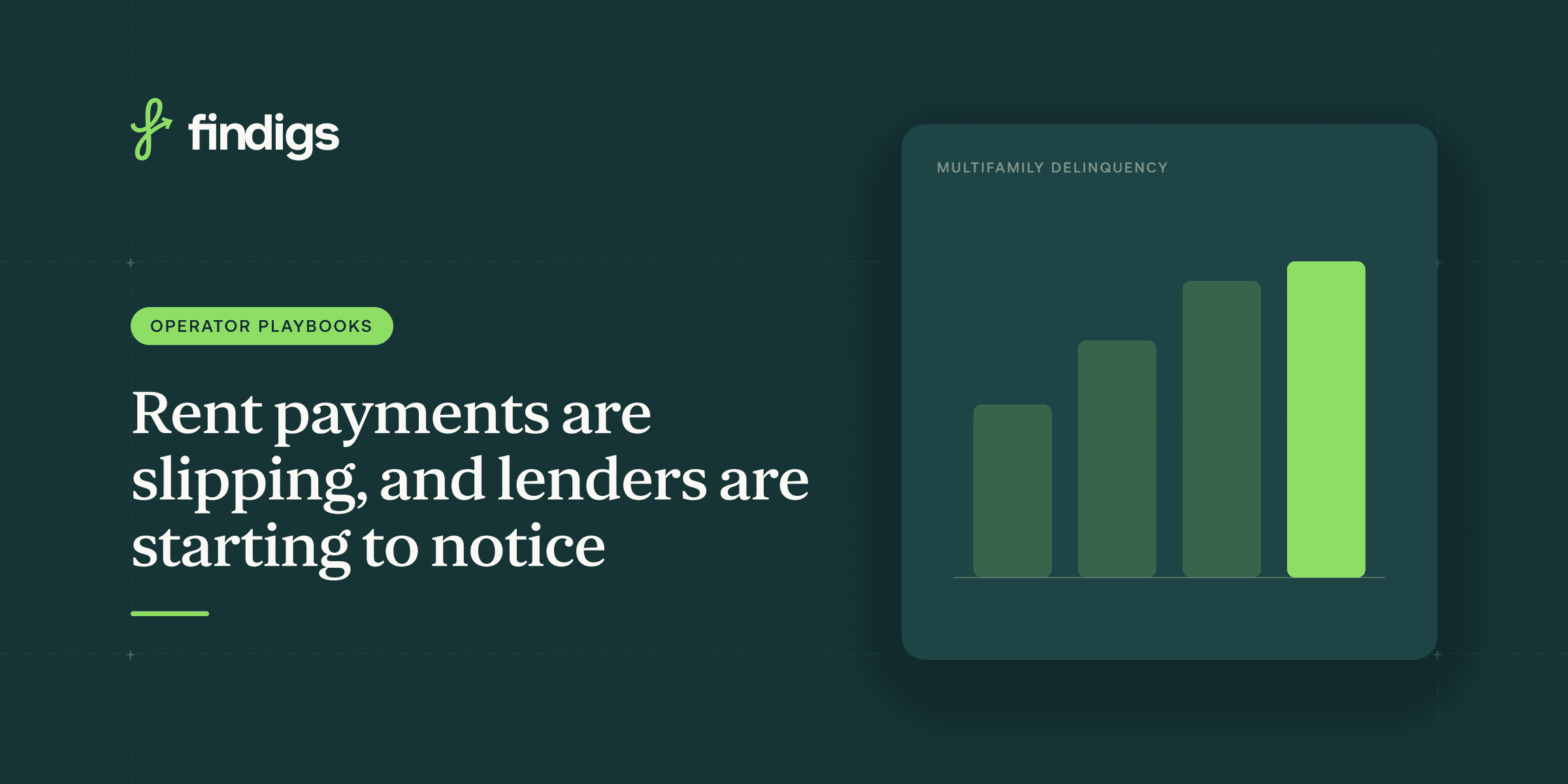
Rent payments are slipping, and lenders are starting to notice
A new Urban Institute survey shows more households paying rent late or partially in 2025, led by renters who earn a moderate living. Freddie Mac's loan data shows that pressure moving up the chain to apartment owners.
Stop screening, start leasing
See how Findigs decisions every application automatically.