Rent payments are slipping, and lenders are starting to notice
A new Urban Institute survey shows more households paying rent late or partially in 2025, led by renters who earn a moderate living. Freddie Mac's loan data shows that pressure moving up the chain to apartment owners.
Key takeaways
- 20% of adult renters under 65 came up short or paid after the due date in 2025
- Among households earning 2 to 4 times the federal poverty level, that share rose 7.3 points in a year
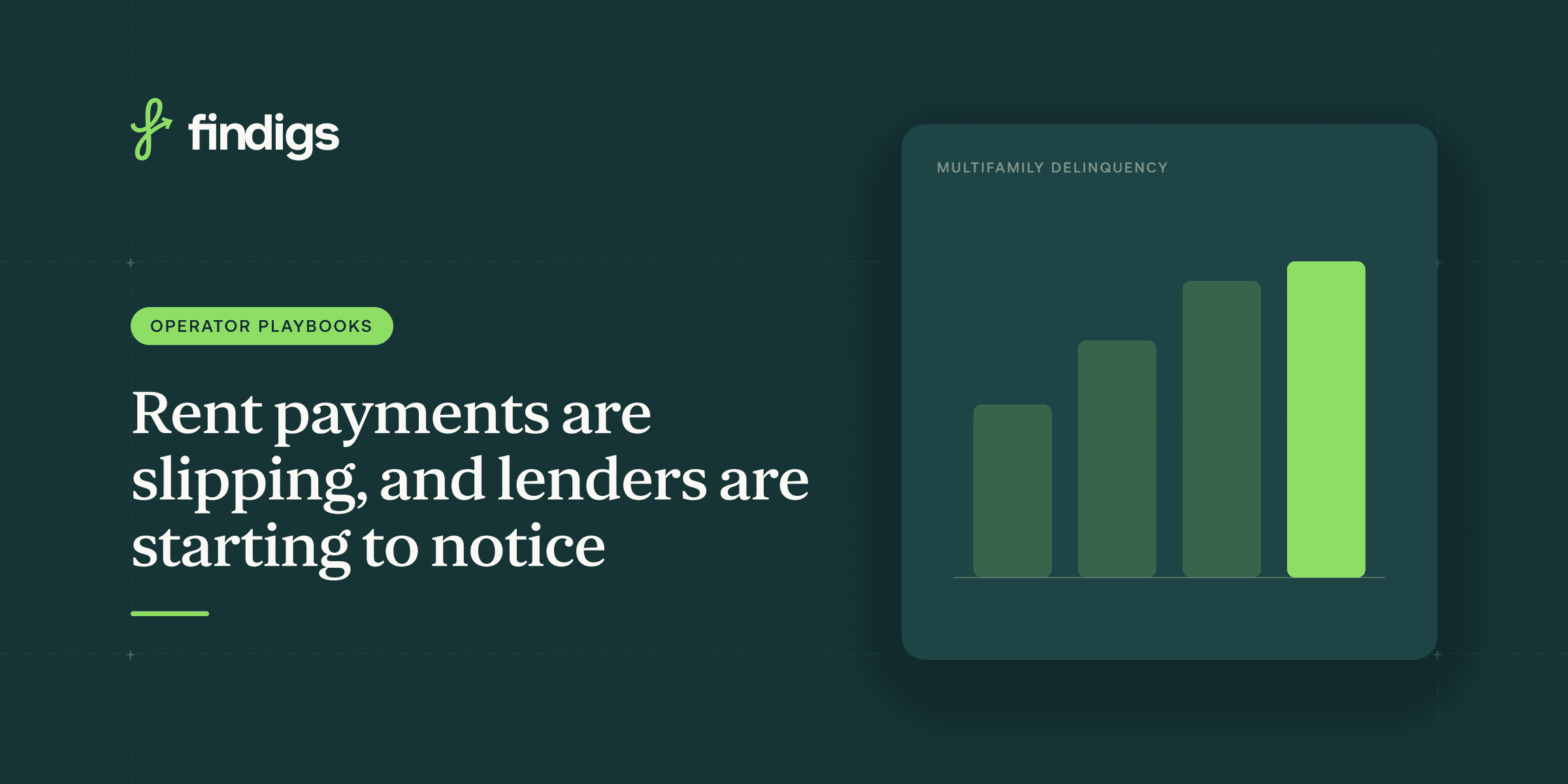
- 0.64% of Freddie Mac's multifamily loans were 60+ days behind in August, nearly double the August 2011 figure
- A strong income ratio at application doesn't guarantee steady payment later
Last year, a growing number of renters couldn't cover rent on time or in full, and notably, households usually seen as financially stable drove the change. That's the takeaway from a survey the Urban Institute published in late September.
According to the 2025 findings, 20% of adult renters younger than 65 paid only part of their rent, or paid it after the due date. A year earlier, the figure was 16.5%. Urban Institute has asked this question every year since 2017 and has never recorded a higher number. It's also the first year-over-year increase large enough to be statistically significant.
Utility bills follow a parallel track. 20.7% of adult renters under 65 couldn't pay a full heating or electric bill last year. That's level with 2023 and 2024, and above every year from 2019 through 2022.
Moderate earners moved the number
Renters at the bottom of the income scale still had the most trouble, with 27.8% reporting a late or partial payment. The growth, though, came from households earning between 2 and 4 times the federal poverty line. For one adult, that's about $31,300 to $62,600 a year. For a household of three, about $53,300 to $106,600. In 2024, 14.3% of these renters reported a rent problem. In 2025, 21.6% did.
The top of the scale saw movement too. Roughly 7% of renters with the highest incomes paid late or partially in 2025, the highest share for that group since 2019, though it’s important to note that Urban Institute found the change too small to be statistically significant.
From the unit to the loan
When rent comes in late, the owner's mortgage payment doesn't wait. Freddie Mac's August 2026 data put 0.64% of its multifamily loans at 60 or more days delinquent. In July it was 0.60%, and in August 2025 it was 0.48%. For comparison, the August 2011 figure, in the aftermath of the housing crash, was 0.35%. The upswing began in February.
Securitized apartment loans point the same way. Trepp's August data shows 7.69% of multifamily CMBS loans delinquent, unchanged from July. In March, the rate had already passed its previous high of 7.12%, set in October 2025.
Trepp ties newly troubled loans to a mix of factors: weaker occupancy, higher costs to run buildings, and cooling demand in certain markets. All three eat into net operating income. The revenue side of that equation gets shaped long before a loan payment is due, at the moment an application is approved.
Rethinking what a good applicant looks like
Many operators approve renters with a fixed income multiple and a credit threshold. Those rules assume income on an application is a fair stand-in for future payment. Urban's numbers complicate that. Depending on rent levels, plenty of households in the 2 to 4 times poverty band would clear a typical income requirement, and that's the group where late and partial payments grew most. Gross pay on an application doesn't show a utility bill that keeps climbing or a grocery budget that's stretched thin.
Raising income minimums or tightening criteria won't fix this. Stricter rules turn away renters who would have paid, and every unit left empty is its own kind of loss. What operators need is a clearer read on which applicants keep paying long after move-in.
Findigs was built for that question. Our decisioning platform returns a yes or no on every application, informed by post-lease performance data, meaning how residents Findigs has approved actually pay over time, rather than one income ratio. Operators using Findigs have reduced bad debt by as much as 60%. More full units, and more rent collected from them, even in a year when household budgets are tight.
Get to occupancy that pays.
Sources
- Urban Institute, “Renters Increasingly Struggle to Pay for Housing” (September 2026)
- Multifamily Dive, Urban Institute renter findings
- Multifamily Dive, “Multifamily CMBS servicing rate declined, delinquencies stayed flat in August: Trepp”
- Multifamily Dive, “Multifamily delinquencies jumped 30 bps in March, as property-level fundamentals deteriorate: Trepp”
- Freddie Mac multifamily serious delinquency figures as reported by CDM
- Findigs, bad debt reduction
Keep reading
AI Tenant Screening: How AI Is Transforming Leasing Decisions
See how AI tenant screening speeds verification, catches fraud, and supports fair housing, and where automated leasing decisioning goes further.

Why a fully integrated application experience can dramatically help your screening process
Learn how a fully integrated rental application and decisioning platform helps property teams reduce manual work, prevent fraud, and move qualified renters forward faster.
Leasing as a brand touchpoint: what renters expect from the application process
Discover how a clear, mobile-first application experience helps property teams build renter trust, improve conversion, and turn leasing into a stronger brand touchpoint.
Stop screening, start leasing
See how Findigs decisions every application automatically.