Why a fully integrated application experience can dramatically help your screening process
Learn how a fully integrated rental application and decisioning platform helps property teams reduce manual work, prevent fraud, and move qualified renters forward faster.

Resident screening should help property teams make confident leasing decisions quickly. But in many organizations, the application experience is split across disconnected systems, manual review steps, third-party reports, and follow-up workflows.
That fragmentation slows down decisions, creates inconsistent applicant experiences, and leaves onsite teams responsible for piecing together the answer that matters most: Can we approve this renter or not?
A fully integrated application experience changes that. Findigs brings the entire resident application and decisioning process into one connected platform, instead of treating screening as a collection of reports.
Applicants move through a guided application experience. Findigs verifies the information that matters, evaluates fraud risk, applies property-specific criteria, and delivers an automated yes/no decision. Property teams get a completed decision instead of another task to manage.
The problem with traditional rental screening
Most screening workflows were built around information gathering, not decisioning.
A typical process may include an application form, credit and background checks, income verification, fraud review, document collection, manual exceptions, and policy interpretation. Even when each step works on its own, the overall process can still feel slow and fragmented.
Property teams often have to move between systems to collect, verify, and interpret applicant information. Conditional approvals, exceptions, and edge cases often create manual work.
Applicants may receive repetitive requests, unclear next steps, or delayed communication.
Inconsistent workflows can create risk across properties, teams, and markets.
Screening gives teams information. Findigs gives teams an answer.
Why fragmentation hurts the entire process
Fragmentation affects more than operational efficiency. It can influence conversion, occupancy, fraud exposure, and team capacity.
When leasing teams have to chase documents, interpret screening results, or escalate exceptions manually, every application becomes harder to move through the funnel. Qualified renters lose patience and risky applications slip through as teams spend time on administrative review instead of leasing.
- Slower decisions: Every handoff adds time.
- More manual work: Teams become responsible for connecting the dots.
- Higher drop-off risk: Applicants expect fast, digital-first experiences.
- Inconsistent decisions: Different reviewers may interpret the same information differently.
- More exposure to fraud: Disconnected checks can miss patterns across identity, income, documents, and behavior.
What a fully integrated application experience looks like
Findigs is built to run the full application-to-decision process end-to-end. That includes screening, underwriting, marketing optimization, and financial services in one connected platform, rather than asking operators to stitch together point solutions for each step.
Each part of the process affects the next. The quality of the application experience influences conversion. Screening and underwriting shape risk. Decision criteria affect occupancy, delinquency, and portfolio performance. When those workflows live in one platform, operators can move from fragmented screening activity to a more complete decision infrastructure.
From there, the core parts of the renter journey flow through a single workflow. Applicants, property teams, and leasing managers are not moving between separate tools for applications, screening, fraud prevention, income verification, document review, and decisioning. Findigs connects those steps so the process can end in a clear decision.
One application
Applicants complete one guided application experience instead of navigating disconnected portals and follow-up requests. This creates a clearer path for renters and gives property teams a more complete view of each applicant from the start.
One platform
All required data, checks, and verifications flow through a connected system. That includes identity, income, credit, background, fraud signals, documents, and property-specific screening criteria.
The decision is only as strong as the context behind it. When every input lives in one platform, teams can reduce duplicate work and make policy application more consistent.
One decision
The platform does not stop at providing reports. It applies the property’s criteria and delivers a yes/no decision automatically when possible. When an application includes conditions, exceptions, or edge cases, Findigs’ internal team does the work required to reach the decision. That means onsite teams are not left interpreting complicated files or managing manual review.
That work is also how marginal applications become signed leases: across the Findigs network, approval rates average 49.1% without decisioning and 51.4% with it.
How Findigs helps property teams
A fully integrated application experience does more than improve individual application workflows. It gives operators better visibility into how decisions are happening across the portfolio.
With one platform managing the application-to-decision process, property teams can better understand approval rates, conditional outcomes, fraud trends, review bottlenecks, and policy performance.
This creates a feedback loop that traditional screening cannot easily support. Instead of only asking whether a single applicant passed a screen, operators can ask how their decision process affects occupancy, fraud exposure, team workload, and revenue quality over time.
Faster leasing decisions
When applications, verification, and decisioning happen in one place, teams can move qualified renters forward faster. This helps reduce delays that can contribute to vacancy loss.
Less work for onsite teams
Leasing teams should not have to act as underwriters, fraud analysts, or document reviewers. A decisioning platform removes much of that burden by:
- Consistently applying criteria.
- Optimizing said criteria to maximize occupancy and minimize delinquency.
- Managing exceptions.
- Delivering the final decision.
More consistent policy application
A connected platform applies the same rules across applicants, properties, and teams. This helps reduce variability and gives operators more confidence in their process.
Better applicant experiences
Applicants benefit from a clearer, more guided process, directly on their mobile device. They know what is required, receive fewer repetitive requests, and get decisions faster.
Findigs delivers a 3.4-hour median decision time for applications. 45% of applications are decisioned outside of traditional business hours.
Stronger fraud prevention
An integrated platform can verify identity and validate income, documents, and device behavior. That connected context makes it easier to detect risk before it becomes a signed lease problem. In fact, operators see an 80% reduction in eviction rates, on average.
From screening reports to decision infrastructure
Rental applications should not require property teams to stitch together disconnected reports, systems, and manual review steps.
Findigs gives operators a better way forward: one application for renters, one platform for teams, and one decision that moves the process forward.
As resident screening evolves, the platforms that create the most value will not be the ones that simply provide more data. They will be the ones that turn that data into faster, more consistent, and more confident decisions.
Tyler Stafford is Product Marketing Lead at Findigs, after MeetElise and DailyPay. He writes about the product, renter hub, and screening tool comparisons.
Frequently asked questions
What does an integrated rental application process actually replace?
An integrated application process replaces handoffs between separate application, verification, screening, and decision workflows with one connected path from applicant intake to decision.
- Map every system an applicant or leasing employee touches between application and approval.
- Identify duplicate data entry and repeated document requests between those systems.
- Flag steps where onsite teams must interpret reports or manually move information.
- Prioritize integration around the handoffs creating the most delays and applicant friction.
See how Findigs structures the application experience around a connected screening workflow.
Why is connecting screening and decisioning better than collecting screening reports separately?
Connecting screening and decisioning turns verified applicant information into an actionable outcome instead of leaving leasing teams responsible for interpreting multiple reports.
- Define approval criteria before applicant data reaches underwriting.
- Evaluate identity, income, credit, background, and other required inputs within the same workflow.
- Apply property-specific criteria consistently rather than relying on reviewer interpretation.
- Route genuine exceptions appropriately instead of making every application a manual task.
Explore how Findigs approaches underwriting decisioning.
How does Findigs combine fraud detection with the broader screening process?
Findigs evaluates fraud risk alongside other applicant information so identity, income, documents, and related signals can contribute to a more connected screening decision.
- Identity verification can establish greater confidence in who is applying.
- Income verification provides stronger context around an applicant’s reported earnings.
- Document analysis can surface potential manipulation or inconsistencies.
- Connected signals reduce dependence on leasing employees spotting suspicious information manually.
Explore Findigs’ approach to identity verification and its role within the broader screening workflow.
How does Findigs help move leasing teams from screening reports to completed decisions?
Findigs combines screening inputs, property-specific criteria, underwriting, and decisioning so leasing teams receive an outcome rather than another collection of reports to interpret.
- Operators define the criteria that should govern underwriting.
- Applicant information and required screening inputs move through a connected workflow.
- Criteria can be applied systematically instead of reviewer by reviewer.
- Exceptions can be handled within the decision process rather than pushed back to onsite teams as unfinished screening work.
Learn more about the broader Findigs platform for application screening, underwriting, optimization, and portfolio data.
Keep reading
Introducing: The State of Decisioning by Findigs
Our first quarterly benchmark follows a rental application from submission to a year after move-in, built from Findigs platform data, not a survey.
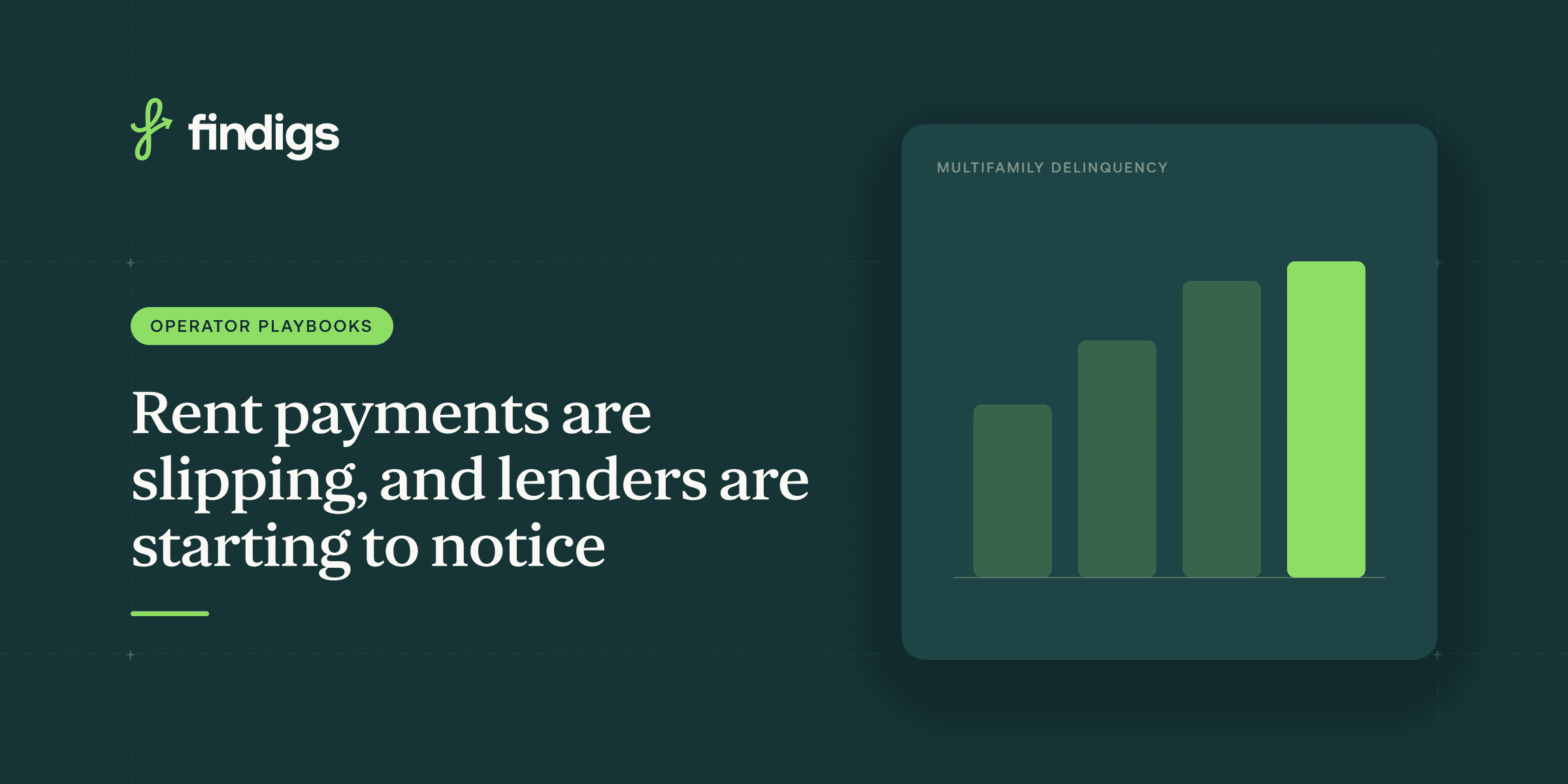
Rent payments are slipping, and lenders are starting to notice
A new Urban Institute survey shows more households paying rent late or partially in 2025, led by renters who earn a moderate living. Freddie Mac's loan data shows that pressure moving up the chain to apartment owners.
AI Tenant Screening: How AI Is Transforming Leasing Decisions
See how AI tenant screening speeds verification, catches fraud, and supports fair housing, and where automated leasing decisioning goes further.
Stop screening, start leasing
See how Findigs decisions every application automatically.